Blog SEO Marketing: Your Practical Guide to Scaling Organic Growth

Blog SEO marketing is a system for getting your blog content to rank on search engines like Google. It’s a mix of smart keyword research, genuinely helpful writing, and technical optimization to pull in organic traffic and turn visitors into customers. Today, the most effective strategies use AI and automation to do this at a massive scale, and it's easier to get started than you think.
The New Playbook for Blog SEO Marketing
Forget the old "write a post and hope for the best" approach. Winning at blog SEO marketing today is all about building a scalable content engine. The game has moved beyond single articles; it's now about creating a strategic system that blends smart automation with a real understanding of what your audience is searching for.
This shift turns your blog from a simple collection of posts into your number one tool for driving organic growth. The real goal is to cement your brand's authority, create a predictable stream of leads, and completely own your niche by systematically answering every single question your potential customers have.
Demystifying Programmatic SEO and AI
At the heart of this new playbook are two ideas that sound complex but are actually very straightforward: programmatic SEO and AI-powered content. Let's break them down in simple terms.
Programmatic SEO is just a fancy name for a simple strategy: creating lots of content that targets very specific, long-tail keywords. Think of it like this: instead of writing one huge article about "coffee," you create 50 smaller articles answering questions like "how to make cold brew at home," "best coffee beans for espresso," and "what is a flat white coffee." You're covering a topic from every possible angle. You can dive deeper into this with our detailed guide on what programmatic SEO is.
AI-powered content is simply using tools like ChatGPT to help you create this content faster. It's not about letting a robot write everything for you; it's about using AI as a powerful assistant to generate ideas, outlines, and first drafts, which you then refine with your own expertise.
Why This Approach Is So Effective
This strategy is incredibly powerful because it mirrors how real people search. Most people don't just type "coffee" into Google; they ask specific questions. By creating content that directly answers these questions, you attract highly motivated visitors.
The numbers don't lie. Businesses that manage to publish 16 or more posts per month generate 4.5 times more leads. Why? Because frequent, targeted publishing builds a massive keyword footprint and boosts visibility across the board. This lines up perfectly with Google's focus on comprehensive, user-first content, making it a proven path to real growth.
The real power of modern blog SEO isn't just publishing more; it's about systematically covering every corner of your niche with helpful, targeted content. This turns your blog into an unbeatable resource for both users and search engines.
Ultimately, this modern approach to blog SEO marketing gives you a repeatable process to turn ideas into high-ranking assets that drive tangible business results.
Building Your AI-Powered Content Engine: A Practical Guide
Alright, let's get practical. Building an AI-powered content engine doesn't require a team of developers or complex code. It's about setting up a smart, repeatable workflow. Here’s a step-by-step guide for beginners on how to implement programmatic SEO using AI.
The core idea is simple: take one broad topic, use AI to find hundreds of specific questions people ask about it, and then use AI again to help you create content that answers those questions at scale.
This whole process can be broken down into a few key phases, showing how a solid strategy feeds into automation, which in turn drives measurable growth.
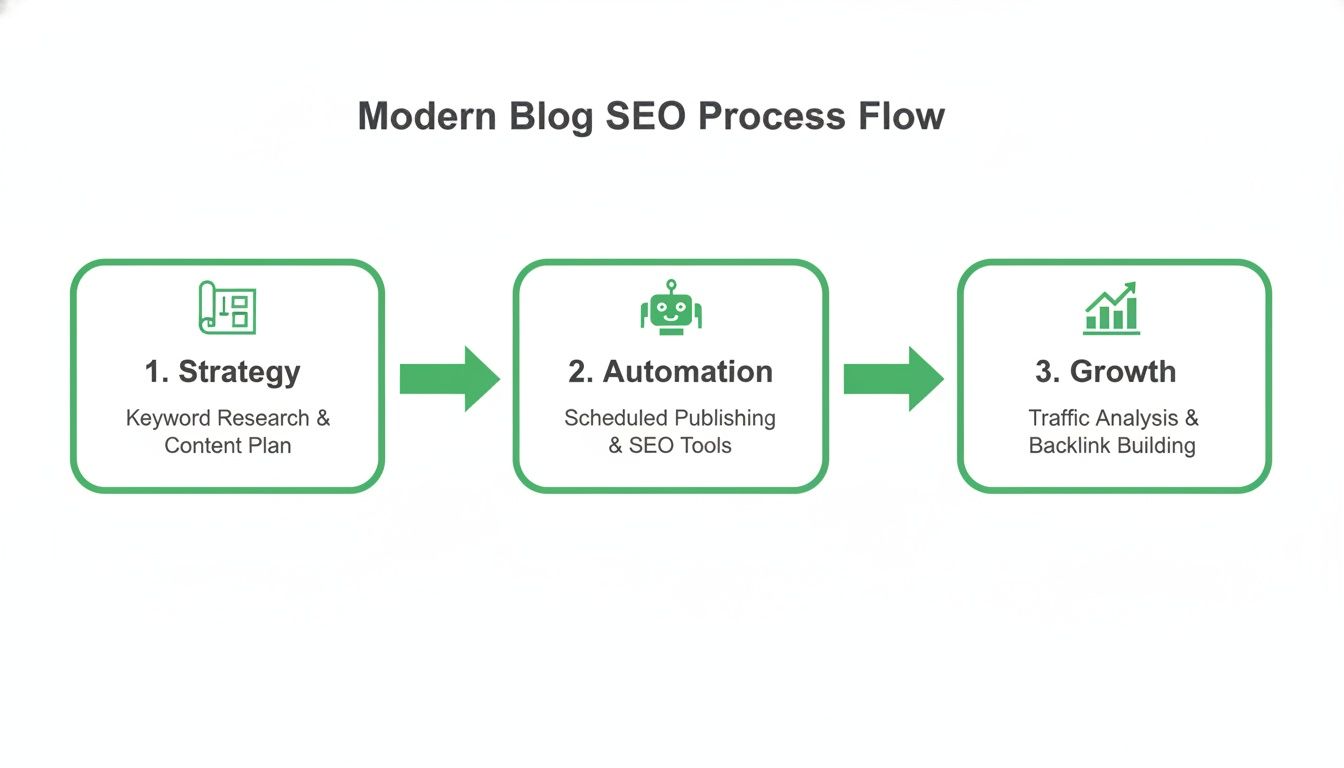
Step 1: Find Hundreds of Content Ideas with AI
First, you need a big list of article ideas. Forget spending hours with complicated keyword tools. You can do this in minutes with an AI tool like ChatGPT.
Start with a single "seed" topic related to your business. Let's say you sell eco-friendly packaging.
Go to ChatGPT and use a simple prompt like this:
Example Prompt to Generate Keyword Ideas:
"My business sells 'eco-friendly packaging'. Act as a marketing assistant. Give me 100 long-tail keyword ideas that a small business owner might search for. Group them into categories like: 'how-to' questions, comparisons, cost-related, and material-specific."
In a few seconds, you'll have a structured list of ready-to-use article titles like "how to ship products sustainably," "compostable mailers vs. recyclable boxes," and "affordable eco-friendly packaging for startups." You've just built your content plan for the next few months.
Step 2: Create Content Outlines with AI
Now that you have your topics, you need to structure them. An outline is a roadmap for your article. AI can create a detailed, SEO-friendly outline for any topic instantly.
Pick one of the keywords from your list, for example, "are compostable mailers waterproof?"
Use this prompt in your AI tool:
Example Prompt to Create an Outline:
"Create a blog post outline for the keyword 'are compostable mailers waterproof?'. The audience is e-commerce store owners. Include a short introduction, a section explaining what compostable mailers are made of, a section directly answering if they are waterproof, a section on their limitations, and a conclusion summarizing the key points."
This ensures every article is well-structured and covers the topic thoroughly before you even start writing.
Step 3: Generate First Drafts at Scale
This is where you see the true power of AI. With your keywords and outlines ready, you can generate first drafts for all your articles. The process of turning structured data into articles is a core part of Natural Language Generation.
To do this efficiently, create a "master prompt" that you can reuse for every article.
Example Master Prompt for a Blog Post Draft:
"Write a 1,000-word blog post using the following outline for the keyword '[Insert Keyword Here]'. The tone should be helpful and easy to understand for a beginner. The audience is small business owners. Start with a compelling introduction and end with a practical summary.
Outline: [Paste the AI-generated outline from Step 2 here]"
By simply swapping the [Insert Keyword Here] and pasting the corresponding outline, you can generate dozens of well-structured drafts in a single afternoon. Remember, these are drafts. The next step is to add your human touch.
This isn't about creating spam. Programmatic SEO is about using AI to systematically produce high-quality, helpful answers to very specific user questions at a scale that's impossible for a human team to match.
This system turns your blog from a sporadic, "when we have time" activity into a predictable and powerful machine for driving organic growth.
Tweaking AI Content for Readers and Rankings

Getting content created at scale is a massive win, but it’s really only half the job in blog seo marketing. The real work begins when you take those AI drafts and refine them, pushing them from good enough to great. This is where your human expertise becomes a serious competitive advantage.
Your goal is to polish that draft until it embodies Google's quality standards, known as E-E-A-T: Experience, Expertise, Authoritativeness, and Trustworthiness. While it's not a direct ranking factor you can code for, it's the lens through which Google assesses whether your content is truly helpful and credible.
Think of the AI draft as a solid framework. Your job is to add the muscle, personality, and genuine insight that makes it connect with a human reader—and signal quality to search engines.
Weaving in Your E-E-A-T
Google is getting better and better at spotting content that lacks a real human behind it. An AI can scrape and summarise what’s already on the internet, but it can’t share a personal failure, a hard-won lesson, or a unique viewpoint from your corner of the industry. That’s your job.
To infuse E-E-A-T into your AI-generated drafts, concentrate on these actions:
- Share Real Stories: Swap out generic examples for actual scenarios from your own work. Did a certain tactic blow up in your face? Talk about it and what you learned.
- Bring Your Own Data: Have you run a survey? Do you have internal data or a specific case study that no one else has? Add it. Original information is pure gold and almost impossible to replicate.
- Fact-Check Everything: AI tools can hallucinate or pull outdated information. Always verify every statistic, fact, and technical detail. This is a non-negotiable step for building trust.
Keep in mind, Google has clear guidelines on what it considers auto-generated content. Taking these extra steps helps ensure your articles are treated as valuable, human-edited resources, not low-effort spam.
Nailing the On-Page SEO Basics
Once the content quality is there, it's time for some simple on-page optimisation. These are the basic but critical signals that tell search engines exactly what your content is about. You don't need to be an SEO guru to get these right.
The most important elements are your titles and headings. Your main title (the H1 tag) needs to grab attention and include your primary keyword. Your subheadings (H2s and H3s) should break up the text into logical sections and use related keywords.
In the German market, for example, where organic search accounts for nearly 47% of all website traffic, these small technical details can make a huge difference. Securing the top spot on Google can land you a 39.8% click-through rate (CTR), and a simple tweak like adding a keyword to your URL can boost that CTR by another 45%. You can find more stats like this over at SERanking.com's SEO performance breakdown.
Your title tag is the single most important piece of on-page real estate you have. It shows up in browser tabs and, more importantly, in search results. Keep it clear, concise (around 40-60 characters is the sweet spot), and focused on what the user wants to achieve.
Finally, don't sleep on your images. Every image needs descriptive alt text. This isn't just for accessibility; it gives search engines another contextual clue about your page. Instead of "chart.png," your alt text should be something like, "Bar chart showing the increase in organic traffic after implementing internal linking."
Building Your Internal Linking Web
The final piece of this puzzle is connecting your content together. Internal linking—linking from one page on your website to another—is one of the most powerful and overlooked parts of a solid blog seo marketing strategy. It does three crucial things simultaneously.
First, it helps search engines crawl your site and understand the relationships between your articles. When you link several related posts back to a central, foundational "pillar" page, you create a topic cluster. This is a massive signal to Google that you're an authority on that subject.
Second, it keeps people on your site longer. A strategically placed internal link can guide a reader from one helpful article to the next, which deepens their engagement and builds trust in your brand.
And lastly, it spreads authority (or "link equity") throughout your site. Links from your highest-performing pages can give a little SEO boost to newer or less-visible posts. Over time, this creates a powerful, interconnected web that lifts the performance of your entire blog.
Automating Your Workflow and Measuring What Matters
A winning blog seo marketing strategy isn't just about writing good articles. It’s built on a slick, automated workflow that frees you up from the manual grind so you can focus on what actually grows your traffic.
Think of it as building a well-oiled machine. This system ensures your ideas move from keyword research to a fully optimised, published post with as little friction as possible.
But here’s the thing: speed and scale mean nothing if you’re measuring the wrong stuff. The real goal is to get past vanity metrics (like total page views) and lock onto the data that reveals the true impact of your work. Tracking the right key performance indicators (KPIs) is what turns a content engine into a predictable source of business growth.
Ultimately, this is about creating a data-driven feedback loop where performance metrics tell you exactly what to do next.
Building Your Content Pipeline
The first step is to map out a clear, repeatable process for every single article. This isn’t about being rigid; it’s about creating a smooth path that kills decision fatigue and keeps everyone on the same page. A solid pipeline has a few key stages, each powered by specific tools that help automate the heavy lifting.
Imagine an assembly line. An idea goes in one end, passes through several stations where value is added, and comes out the other side as a polished, high-performing blog post.
For anyone looking to really level this up, you can even borrow principles from software development. Our guide on implementing CI/CD for content creation dives deep into this super-systematic approach.
To get you started, here's a look at the essential tools that can power each step of your pipeline.
Essential Tools for Your AI-Powered SEO Workflow
This table breaks down some of our favourite, user-friendly tools for each stage of the programmatic SEO process. They're chosen for their simplicity and the immediate impact they can have on your workflow.
| Stage | Tool Examples | Primary Function | Beginner Friendliness |
|---|---|---|---|
| Keyword Research | AnswerThePublic, AlsoAsked | Uncover long-tail keywords and user questions from a single core topic. | Very High |
| Content Outlining | ChatGPT, Claude | Generate structured outlines, headings, and key points for articles. | Very High |
| Drafting | Jasper, Writesonic | Create initial drafts based on your detailed prompts and outlines. | High |
| SEO Optimisation | Surfer SEO, Clearscope | Analyse top-ranking content and provide data-driven editing suggestions. | Medium |
| Project Management | Trello, Asana | Track content progress from idea to publication in a visual workflow. | Very High |
Having a structured setup like this ensures your quality and consistency stay high, even when you're producing a large volume of content.
Tracking KPIs That Actually Drive Growth
Once your content goes live, the measurement begins. Your focus needs to be on metrics that tie directly to your business goals. Ditch the obsession with daily traffic spikes and instead monitor the KPIs that signal real, sustainable growth.
The best place to start? The completely free and incredibly powerful Google Search Console. It's not just for techies; it's a goldmine of actionable data for any content creator. It shows you exactly which queries bring people to your site, which pages are performing, and where your biggest opportunities are hiding.
Here are the essential KPIs you should be monitoring:
- Organic Traffic Growth by Topic Cluster: Forget looking at overall site traffic. Zoom in on your topic clusters. Is your "Compostable Packaging" cluster seeing a steady climb in clicks and impressions month-over-month? This tells you if your authority-building strategy is actually working.
- Keyword Ranking Improvements: Track the average ranking positions for the main keywords in each cluster. Seeing your target long-tails move from page three to page one is a crystal-clear sign of progress.
- Click-Through Rate (CTR) by Page: Lots of impressions but a low CTR is a classic sign that your title and meta description aren't grabbing attention. This is often a quick and easy fix that can boost traffic without a full rewrite.
Don't get lost in a sea of data. Focus on just two or three core metrics that align with your primary goal, whether that's lead generation, brand awareness, or direct sales. This clarity makes it easier to see what's working and what isn't.
By checking these indicators regularly, you create that powerful feedback loop. You'll spot underperforming articles that need an update, identify new "striking distance" keywords to target, and be able to double down on the content formats that are clearly hitting the mark. This data-driven approach is what separates a successful blog seo marketing programme from one that just makes a lot of noise.
Promoting Your Content to Drive Real Engagement

Hitting ‘publish’ feels like the finish line, but it’s really just the starting gun. The best-optimised content in the world doesn’t mean a thing if nobody ever sees it. Any effective blog seo marketing plan has to include a smart, proactive strategy for getting your work in front of the right people.
Too many creators fall into the trap of just dropping a link on social media and calling it a day. That's not a strategy. Real promotion is about amplification—taking a single piece of content and spinning it into multiple assets that can tap into different audiences on different platforms.
This is how you transform your blog from a static library into a dynamic traffic-generating engine. Let's dig into a few practical ways to promote your content and connect it to actual business outcomes.
Repurposing Content for Maximum Reach
The single most efficient way to promote your work is to get more mileage from every article you write. Repurposing isn't about making more work for yourself; it's about working smarter. You’ve already done the heavy lifting of research and structuring the information. Now, it's just a matter of repackaging it.
Think about all the different ways people consume information. Not everyone has the time or desire to read a 2,000-word article. Some prefer a quick video, others a visual summary, and many just want the key takeaways delivered to their inbox.
Here are a few high-impact ways to get more out of your blog posts:
- Create a video script from key insights: Pull the main arguments from a successful article and script a short, 2-3 minute video. This could be a simple talking-head recording or a more polished animated explainer.
- Design a shareable infographic: Extract the most important stats, steps, or conclusions and have them designed into an eye-catching infographic. These are absolute gold on platforms like LinkedIn and Pinterest.
- Write a quick email newsletter: Summarise the core message of your article into a concise, valuable email for your subscribers. It’s a brilliant way to drive repeat traffic directly back to your site.
Each one of these repurposed assets becomes its own promotional vehicle, creating new entry points for people to discover your original article and your brand.
Turning Readers into Customers with Smart CTAs
Promotion gets people to your blog, but what happens when they get there? This is where your content needs to do more than just inform—it has to guide the reader toward an action. A well-placed Call-to-Action (CTA) is the bridge between a casual reader and a potential lead.
Let’s be honest, a generic "Contact Us" button at the very bottom of a post almost never works. Your CTAs need to be hyper-relevant to what the person is actually reading. We call this content-specific lead generation.
For instance, if someone is reading your in-depth guide on a complex process, a great CTA would be to offer a downloadable checklist or a free template that helps them put what they just learned into practice.
Don't just ask for the sale. Offer the next logical piece of value. If your blog post explains the 'what' and the 'why', your CTA should offer the 'how'. This builds trust and positions you as a helpful expert, not just a seller.
The key is matching the CTA’s value to the reader's intent. Someone reading a high-level, informational article isn't ready to book a demo. They might, however, be very interested in subscribing to your newsletter for more insights on that topic.
Optimising for Engagement Beyond the Click
Your promotional efforts should also focus on sending the right engagement signals to search engines. This goes way beyond just getting clicks. One often-overlooked area is optimising for how your content shows up directly in search results, especially in features like Google's answer boxes.
These featured snippets often pull information directly from well-structured content—think FAQs, bulleted lists, or clear, concise definitions. Winning these spots can dramatically boost your visibility and click-through rate, even if you aren't the number one organic result.
Effectively optimising for snippets is a powerful promotional tactic in itself. For a deep dive, our guide on featured snippet optimisation provides a practical, step-by-step approach. By structuring your content to directly answer common questions, you make it easy for Google to feature your work—essentially promoting it for you at the very top of the SERP. This final piece helps turn your blog seo marketing efforts into a full-circle system where great content gets seen, drives real engagement, and ultimately delivers business results.
Common Questions About AI and Blog SEO
As you start weaving these modern techniques into your blog seo marketing, a few questions always pop up. Let's tackle the most common ones head-on.
Can I Really Rely on AI for All My Blog Content?
Think of AI as a powerful apprentice, not the master craftsman. The most successful content strategies I've seen are a hybrid: AI does the heavy lifting, and a human expert provides the crucial finishing touches.
AI is fantastic for bashing out structured first drafts, handling initial research, and scaling your output. But a human editor is absolutely non-negotiable. Your job is to inject genuine insights, infuse your brand's voice, fact-check every claim, and make sure the content hits Google's E-E-A-T (Experience, Expertise, Authoritativeness, Trustworthiness) standards. This blend gives you both the scale and the quality you need to win.
Is Programmatic SEO Too Complicated for a Beginner?
Not at all. The term might sound intimidating, but the core idea is simple: you're just systematically answering a huge number of your audience's very specific questions. This is actually a massive advantage for smaller businesses or solo operators.
It lets you target a fleet of low-competition, long-tail keywords instead of getting into a street fight for the big, competitive terms. The AI-driven methods we've covered make this approach accessible to anyone, no coding skills needed.
For newcomers, programmatic SEO is one of the fastest ways to build topical authority and carve out a space in a competitive niche. You're not trying to out-muscle the giants; you're out-smarting them by being more helpful.
How Long Does It Take to See Results from This Strategy?
Let's be clear: SEO is a long game, and this is no exception. While you might see some encouraging signs of life in just 3-4 months, you should expect significant results from a programmatic SEO push to take 6 to 12 months to really come into their own.
You're publishing a high volume of content, and it takes time for Google to crawl and index it all. As that happens, you gradually build authority in your topic cluster. Consistency is the single most important part of this equation. The more high-quality, targeted content you publish on a regular schedule, the faster you'll build momentum and see that organic traffic start to climb.
At Programmatic SEO Hub, we provide the educational resources, templates, and systems to help you master AI-powered content strategies. Explore our free guides and tools to build your own scalable content engine at https://programmatic-seo-hub.com/en.
Related Articles

Unlock the Power of SEO and Content for Higher Rankings
Think of your content as the engine that powers your business. It's what drives you forward. But without SEO, that powerful engine is just spinning its wheels. SEO is the navigation system,...